
Reception Assistant
No question forgotten.
You don't need to be a medical expert to do reception well; you need to know what to ask. Every call follows the polyclinic's scenario, with questions that must not be missed.
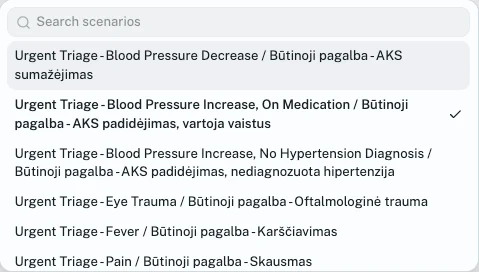
A polyclinic can have dozens of scenarios, written in a ~100-page manual, Word files and colleagues' heads. Under pressure a question gets skipped. New staff take months to learn them, and afterwards nobody can check what was asked.
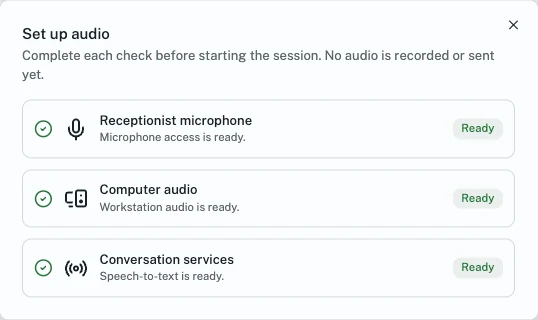
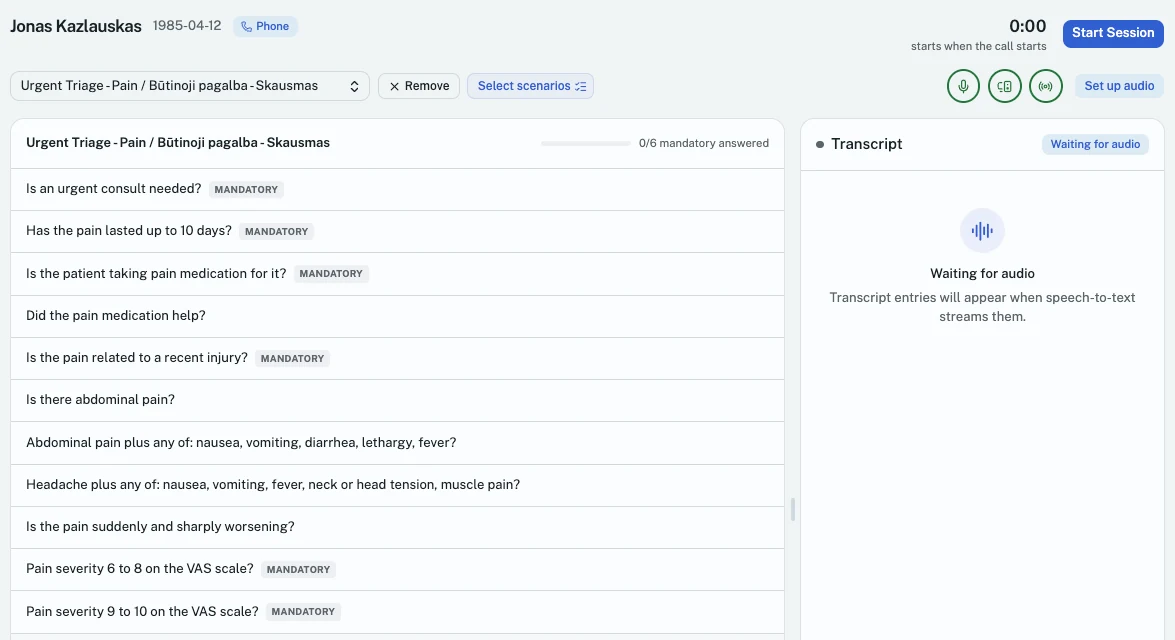
Reception Assistant listens to the call, shows the scenario's questions on screen, ticks them off as they are answered, and reminds the operator of any that are still missing. Every call leaves a record.
The call
PatientMy back has hurt for a week. The painkillers don't help.
The scenario's questions
- Pain for up to 10 days?Yes
- Are the painkillers helping?No
- Pain 6 to 8 out of 10?Yes
- Caused by an injury?No
Next step
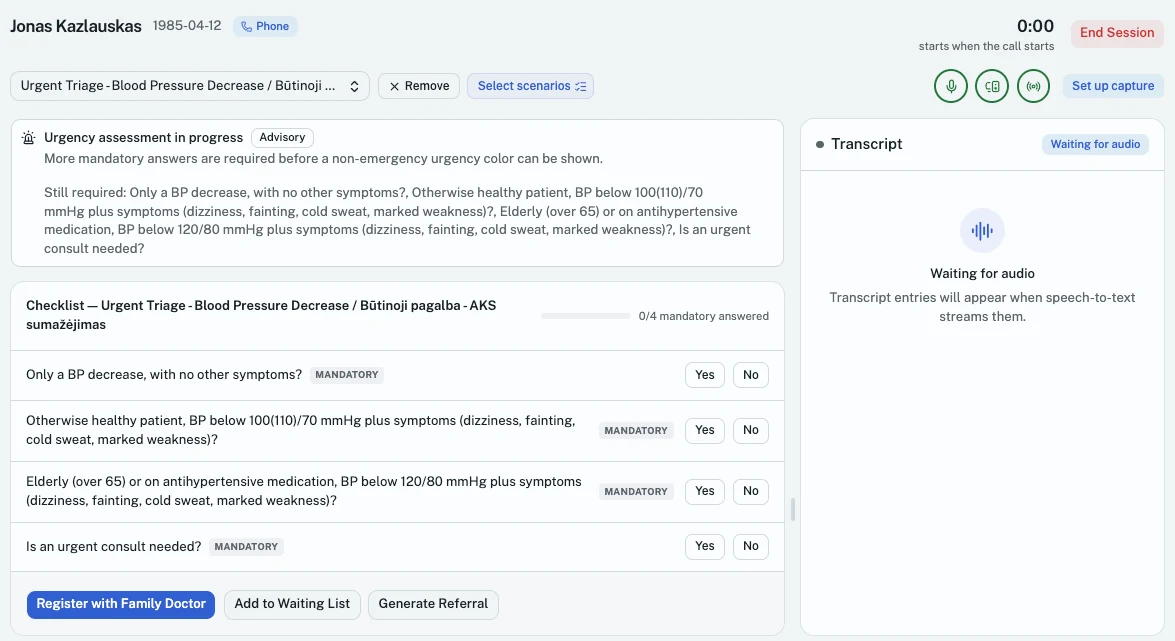
Every required question asked.
Register with family doctor
How it works
The polyclinic's own scenario, on screen during the call.
Problems it solves
What it solves.
- 01
Too many scenarios to remember.
What happens today
Dozens of scenarios, each with its own questions, written in a ~100-page manual. Nobody keeps them all in their head during a busy shift.
What it does
The right scenario and its questions appear on screen during the call.
Pilot metric: time to find the right scenario
- 02
Important questions get skipped.
What happens today
Under time pressure an operator forgets to ask something that matters, and the patient ends up in the wrong place.
What it does
Required questions are marked, ticked off as they are answered, and any missing one is flagged before the call ends.
Pilot metric: share of calls with every required question asked
- 03
Clinical processes, without guesswork.
What happens today
The scenarios reception follows are clinical. Without support, staff guess or interrupt a colleague.
What it does
The assistant walks them through the polyclinic's own process, step by step. The operator stays in charge.
Pilot metric: number of incorrect registrations
- 04
New staff take long to learn.
What happens today
Turnover is high and onboarding relies on the manual and colleagues. New hires make the most mistakes in their first months.
What it does
From day one the screen shows the next question. Nobody has to memorise the manual.
Pilot metric: new-hire ramp-up time
- 05
Nobody can check what was asked.
What happens today
There's no record of which questions were asked or why a patient was sent where. Training is guesswork, and complaints are hard to answer.
What it does
Every call is saved with its scenario, the answers and the next step taken.
Pilot metric: share of calls with a complete record
- 06
Service depends on the language spoken.
What happens today
About a quarter of calls are in Russian, and some of those patients get a shorter conversation.
What it does
The same scenario and the same required questions apply in every language. Russian support is next.
Pilot metric: service-quality gap between languages
Capabilities
What it includes.
Capture the conversation
- Uses the existing microphone and computer audio
- Live Lithuanian transcription
- Explicit session start and finish, with a manual fallback
Follow the scenario
- The scenario's questions shown during the call
- Required questions marked and ticked off
- A reminder for anything not yet asked
- Answers picked up from the conversation as it happens
Take the next step
- Action buttons for each scenario: family doctor, waiting list, referral
- The operator confirms every step
- Patient identification captured
Keep a record
- Every call with its scenario, answers and outcome
- History of assisted conversations
- Patient data export and deletion
Deploy safely
- Organisation and team boundaries
- Named-user access and permissions
- Audit trail, data protection, and capture and retention controls
- Lithuanian and English interface
Talk to us.
Tell us which product interests you, and we'll get back to you.