
Doctor Assistant
Paperwork done before the patient leaves.
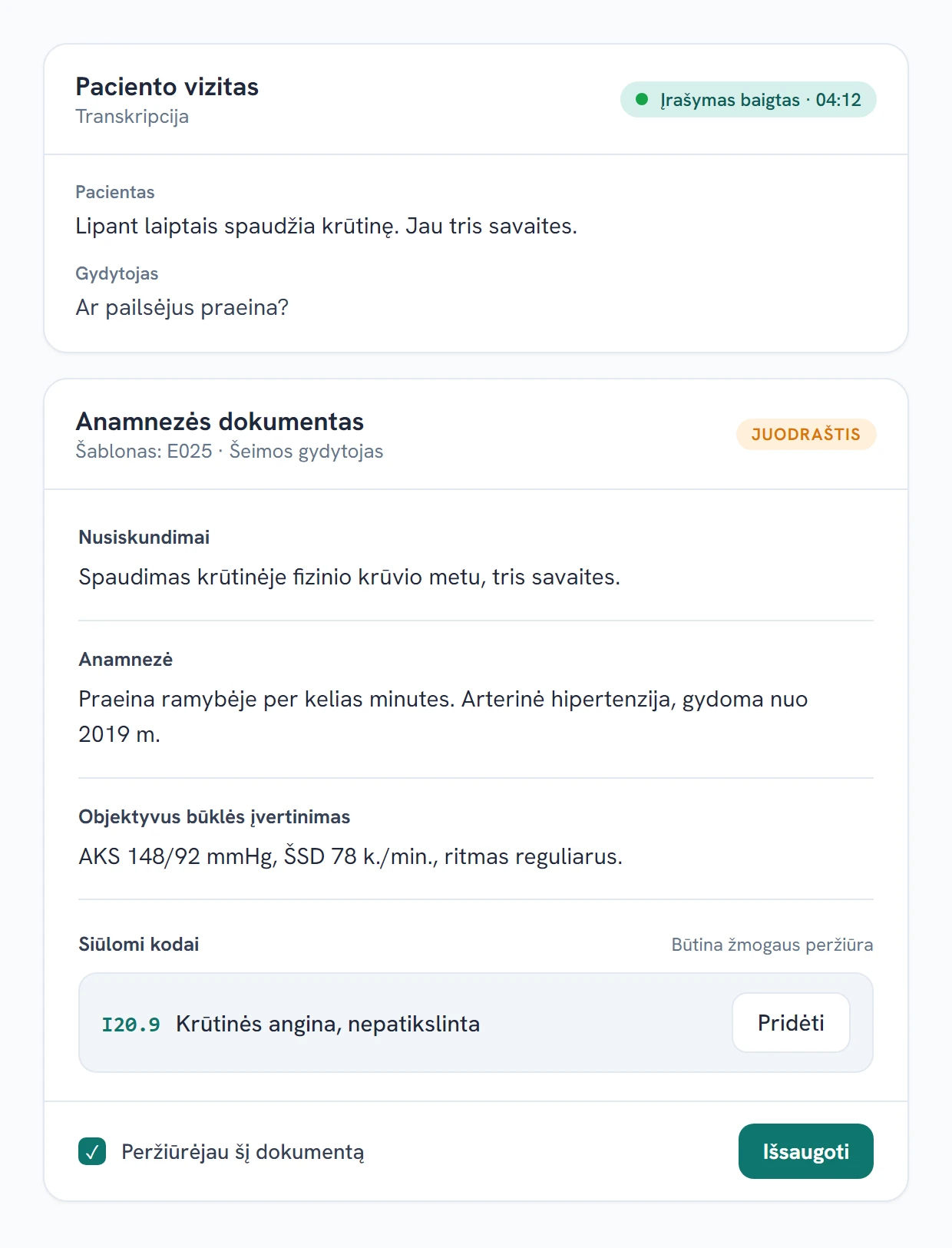
Doctor Assistant listens to the consultation and writes it down automatically. From the conversation it drafts the E025 record, pulls the patient's history from e-health, and suggests diagnosis and service codes.
The doctor no longer fills in records in the evening or searches several systems for information, so more of the visit goes to the patient.
The doctor reviews everything, edits if needed, and signs.
How it works
From visit to signed record.
The essentials
Everything a documentation assistant should do.
The core functions, built for the Lithuanian language and Lithuanian medical records.
- Records and transcribes the consultation
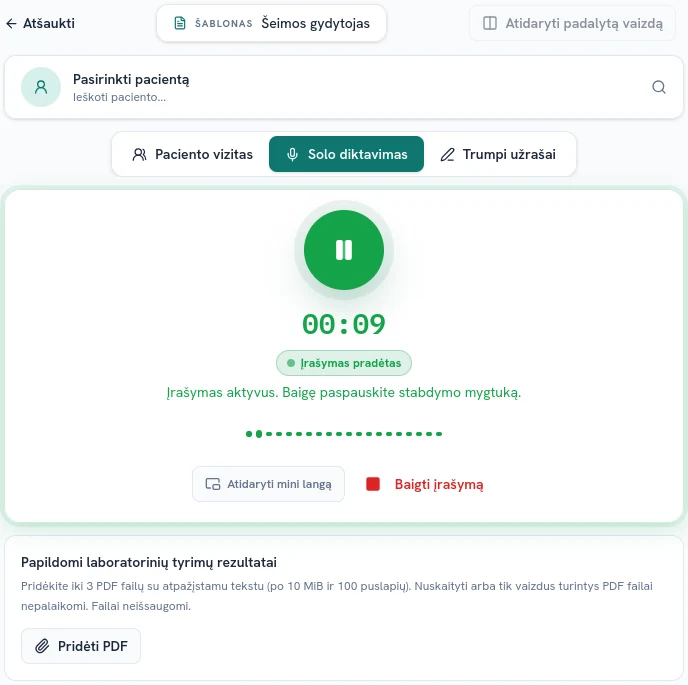
- Four ways in: live visit, dictation, uploaded audio or a few keywords
- A structured E025 draft in clinical language
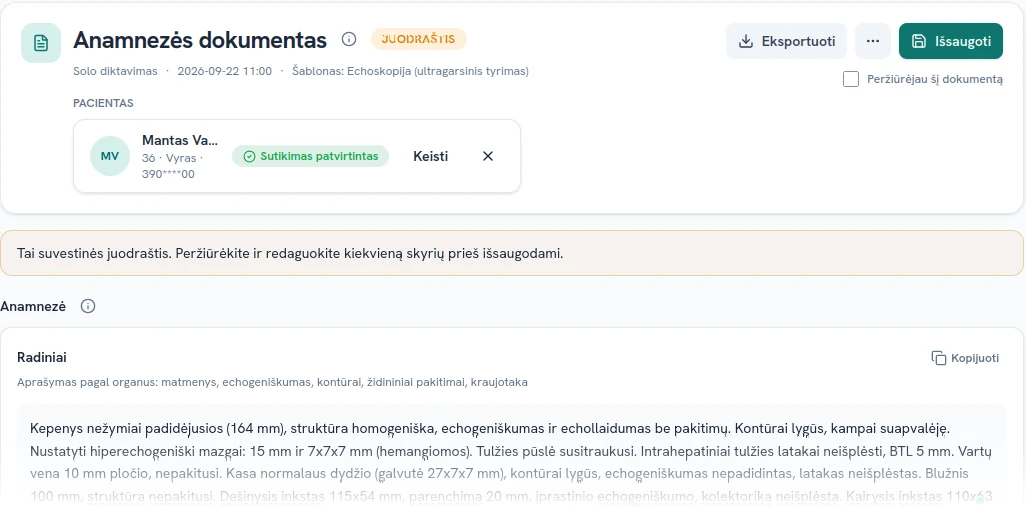
- Templates for family medicine, ultrasound, MRI/CT, cardiology, psychiatry, paediatrics and emergency care
- Writes in the doctor's own documentation style
- Edit any section, then review and sign. The doctor decides.
Beyond the note
And what it does that a dictation tool doesn't.
Doctor Assistant also prepares the visit, codes it, and answers questions about the patient.
The patient's history from e-health, before they walk in.
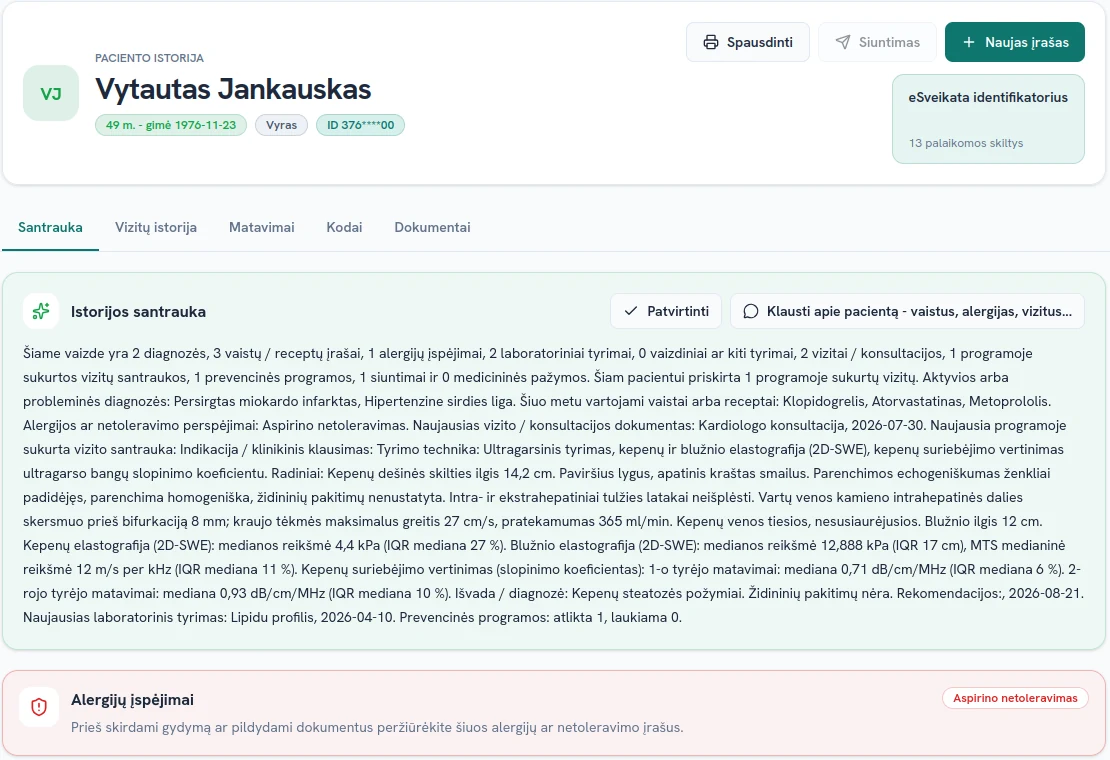
Diagnoses, medication, allergies, visits, tests, referrals and sick leave come from the national e-health system, gathered into one summary and timeline with allergy warnings on top.
Coding inside the documentation.
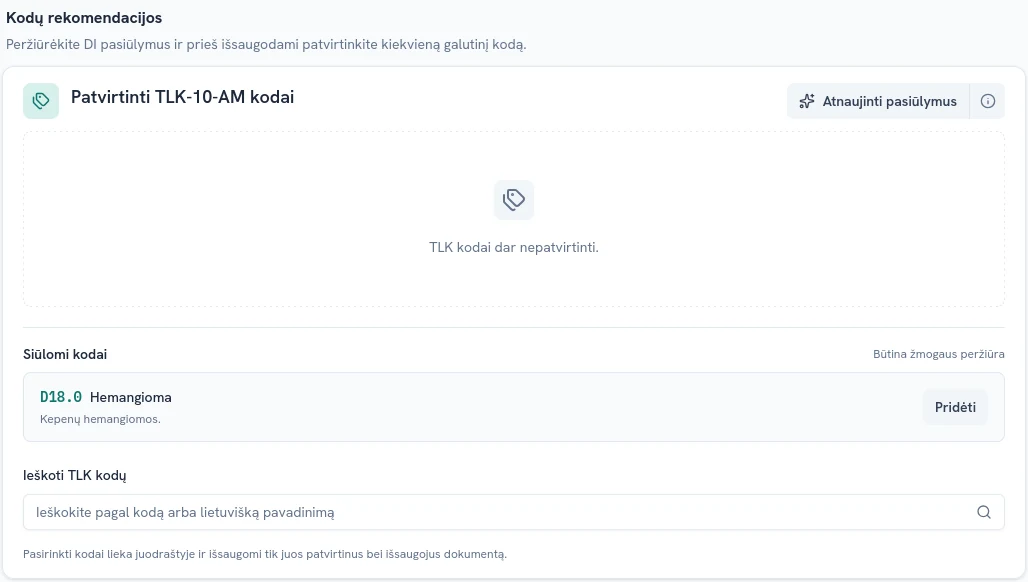
TLK-10-AM, ACHI and PSDF/VLK codes suggested from the document and confirmed by the doctor, because coding decides reimbursement.
Ask the record.
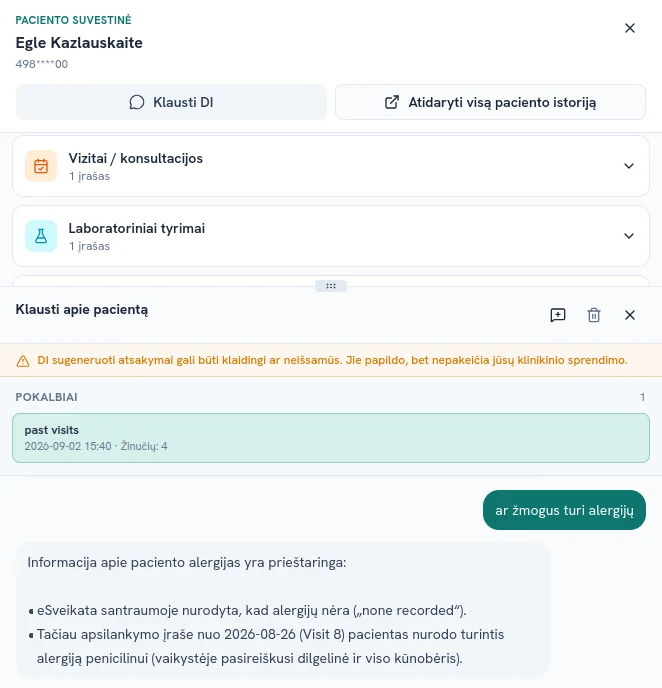
Questions about the patient in plain language, answered from the records, with conflicts between records flagged.
Lab results from PDFs.
Attach laboratory PDFs and use their findings in the assistant and the document, with the supporting excerpts shown.
Lithuanian speech recognition, measured.
5.76% word error rate on general speech and 7.71% on medical speech, at about 71 times real time.
On the institution's servers.
Patient conversations and records stay inside the building, with named users, roles and an audit trail.
Integrations
Fits into the hospital's systems.
Doctor Assistant works with the systems the institution already runs. Connections are set up during deployment, inside the institution's network.
e-sveikata
Patient history from the national e-health system feeds the summary and the timeline.
Foxus
E025 documentation in the Foxus format.
Med.I.S.
Documents prepared for Med.I.S. workflows.
Hospital information system
Finished documents and codes go into the institution's HIS.
Merkys
The Ministry of Health legal base and the institution's own rules, answered inside the doctor's workspace.
Problems it solves
What it solves.
- 01
Documentation competes with the consultation.
What happens today
Listening, assessing and writing happen at once. Unfinished records move to the end of the day, so physician time paid as clinical time goes to documents.
What it does
Records and transcribes the visit and drafts a structured E025 in clinical language, in the doctor's own style. Three inputs: live recording, uploaded audio, or notes and keywords.
The saving is counted after the time spent reviewing and editing. That is the main open ROI question, and the pilot measures it.
- 02
The history is assembled from separate records.
What happens today
Reconstructing a chronic patient's conditions, tests and treatment takes consultation minutes meant for assessment, and gaps make continuity of care harder.
What it does
A Patient Summary and a longitudinal record: diagnoses, allergies, medication, visits, labs, imaging, referrals, vaccinations, prevention, certificates and sick leave, filtered by category and period.
Live with representative data. The full national history opens up once e-health is connected, which is technically ready for a pilot.
- 03
A long e-health history is hard to read safely.
What happens today
Once e-health is connected, the problem flips from too little information to too much. Something important can be missed. That is a clinical-safety issue, not only a time issue.
What it does
Ask the record in plain language, such as when the last blood tests were and what they showed, and get the answer with the records it came from.
- 04
Is the patient entitled to what they ask for?
What happens today
A patient asks for a test or service and the doctor needs grounds for the answer. For the institution this is about liability and patient conflict.
What it does
Answers from the Ministry of Health legal base and the institution's own rules and service standards, powered by Merkys.
Each institution's internal rules are added as implementation work.
- 05
Routine administrative visits use up slots.
What happens today
Prescription renewals and occupational health checks take a visit slot for work of low clinical value.
What it does
Templated visit scenarios for prescription renewal and occupational health checks, inside the E025 flow.
It makes the work easier. It does not remove the requirement for the visit or the certificate.
- 06
A clear record for continuity is hard to write quickly.
What happens today
The essentials must be picked from the conversation and the history without mixing up past and current treatment.
What it does
Structured E025 fields with blood pressure, pulse, height, weight and BMI, plus templates for family medicine, ultrasound, MRI/CT, cardiology, psychiatry, paediatrics and emergency care.
Fewer record errors is a hypothesis. The pilot assesses quality separately from speed.
- 07
Coding is a separate task after documentation.
What happens today
Diagnosis, procedure and service codes have to be found by hand, and coding decides reimbursement from the Compulsory Health Insurance Fund.
What it does
TLK, ACHI and PSDF codes suggested inside the documentation flow. The doctor approves every one.
Example
It reads the whole record, so the line that matters isn't missed.
In a long history the risk isn't too little information. It's too much to review in the time available. The doctor asks a question in plain language and gets an answer from the records, including where those records disagree.
AI answers can be wrong, so the full history stays one click away. The full national history depends on the e-health connection.
Value
How we measure the value.
Two value lines, kept separate in ROI
- 01Documentation — time saved writing anamnesis, filling E025, coding
- 02Information retrieval — time plus clinical safety from a pre-assembled patient summary
What the pilot measures
- History review time before and during the visit, especially for chronic patients
- Time to a finished document, including review, editing and transfer to the HIS
- Documentation work left after the last patient
- Record quality (missing, wrong or unsupported content), assessed separately from speed
- How often doctors actually use it, and their experience
Validation
- Family-doctor testing: strongly positive on usability and speed
- Measured benchmarks: 5.76% ASR WER general, 7.71% medical domain, ~71x realtime
- Interest confirmed by 7+ healthcare institutions
Talk to us.
Tell us which product interests you, and we'll get back to you.